


 PLATFORM UPDATE:


Effect of inorganic electrolytes on the interfacial behavior and foam properties of mixed surfactant systems containing silicone surfactants
 *abc
*abc
Abstract
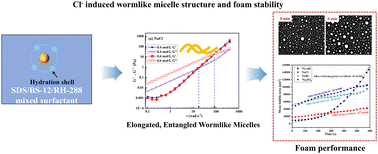
This study investigated the effects of inorganic electrolytes (NaCl, NaBr, and Na2SO4) on the interfacial behavior, rheological properties, and foam performance of a ternary surfactant system composed of sodium dodecyl sulfate (SDS), dodecyl dimethyl betaine (BS-12), and a silicone surfactant (RH-288) at a mass ratio of 10 : 1 : 1. The mixed surfactant system exhibited enhanced surface activity with a critical micelle concentration close to that of RH-288 alone. Upon addition of electrolytes, a sphere-to-worm-like micellar transition was induced, significantly altering the solution's rheological behavior. Unlike NaBr and Na2SO4, NaCl promoted the formation of elongated and densely entangled worm-like micelles with long relaxation times, resulting in pronounced viscoelasticity. Although foamability slightly decreased with salt addition, foam stability markedly improved, as evidenced by reduced drainage, slower bubble coarsening, and enhanced thermal resistance up to 80 °C. Cryogenic transmission electron microscopy (cryo-TEM) confirmed the presence of worm-like micellar networks in the NaCl-containing system. The results demonstrated that anion-specific effects, interpreted by the Hofmeister series, played a critical role in modulating micellar dynamics and foam stability. Furthermore, the dynamic relaxation characteristics of the micellar network should be regarded as a key factor alongside bulk viscosity. The SDS/BS-12/RH-288 system with 0.4 mol L−1 NaCl shows great potential as a high-performance, environmentally friendly, fluorine-free foam extinguishing agent. This study can provide a suitable approach to develop fluorine-free foam extinguishing agents for forest and grassland firefighting.
 Please wait while we load your content...


