


Hydrogen bond-triggered self-healing polyurea elastomers with mechanical robustness via dual-dynamic phase structure construction

Abstract
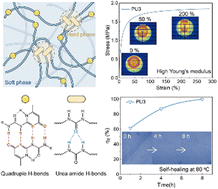
High-performance elastomers always suffer from the trade-off between the ability of self-healing and mechanical stiffness. Here we report a hierarchical, synergistic hydrogen-bonding design that overcomes this trade-off. By integrating quadruple hydrogen bonds with moderately dynamic hydrogen-bond clusters within the hard domains of polyurea, we create a dual-dynamic, decoupled phase architecture that simultaneously imparts rigidity and enables reversible molecular reconfiguration. This interplay of strong and dynamic interactions generates robust hard domains that reinforce mechanical strength while preserving rapid, thermally activated self-healing. The resulting polyurea exhibits near-complete recovery of mechanical performance (≈100% at 80 °C after 8 h) together with a high Young's modulus of 24.2 MPa. This work demonstrates a rational strategy to reconcile the conflicting demands of self-healing and stiffness in polymeric materials through a hierarchical synergistic hydrogen-bonding system.
 Please wait while we load your content...


