


 PLATFORM UPDATE:


Modeling of the field-induced electrization of a magnetoelectric PVDF@cobalt ferrite filament
 †a
and
Yuriy L.
Raikher
†*a
†a
and
Yuriy L.
Raikher
†*a
Abstract
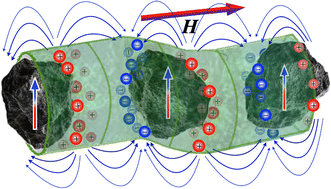
A numerical modeling of the field-induced electrization in a magnetoelectric composite filament of polyvinylidene fluoride (PVDF) filled with cobalt ferrite (CFO) nanoparticles is performed. The filament is considered in the framework of the representative volume element (RVE) scheme, and two configurations of the particle magnetic moments are taken as examples: parallel (structure I) and anti-parallel (structure II). Under an applied magnetic field, the magnetostrictive and magnetorotational effects in the CFO particles induce mechanical stresses in the PVDF matrix, which, due to its piezoelectric properties, generate electric polarization. The resulting electric potential distributions on the filament surface and in the surrounding space are obtained with the aid of the finite element method. Key findings reveal that structure I exhibits a transverse polarization with higher electric potential, while structure II shows a helical charge distribution with more tightly localized fields. The results provide insights into the design of magnetoelectric filaments intended for regenerative medicine and flexible electronics, detailing the interplay between the electromagnetic properties and structure of the composites under study.
 Please wait while we load your content...


