


Sequence-defined phase behavior of poly(N-isopropylacrylamide-co-acrylamide) in water
 ab
Tarak K.
Patra
*ac
ab
Tarak K.
Patra
*ac
Abstract
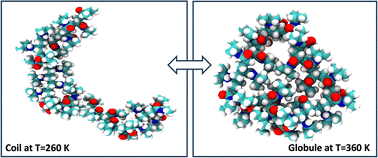
The precise arrangement of different chemical moieties in a polymer determines its thermophysical properties. How the sequence of moieties impacts the properties of a polymer is an outstanding problem in polymer science. Herein, we address this problem for the thermoresponsive property of poly(N-isopropylacrylamide-co-acrylamide) in water using all-atom molecular dynamics (MD) simulations for temperatures ranging from 260 K to 360 K. Our simulations classify four distinct classes of thermoresponsive behavior in PNIPAM-co-PAM: (i) sequence exhibiting lower critical solution temperature (LCST) behavior, (ii) sequence exhibiting upper critical solution temperature (UCST) behavior, (iii) sequence displaying both LCST and UCST transitions, and (iv) sequence showing no discernible phase transition within the investigated temperature range. The critical temperature exhibits a strong correlation with the mean block length in periodic sequences displaying LCST-type behavior. This variability in thermoresponsive property is found to be closely linked to the extent of hydrogen bond formation in the system. These findings offer new directions in the design of structurally diverse thermoresponsive copolymers.
 Please wait while we load your content...


