


 PLATFORM UPDATE:


Mimicking natural photosynthesis: converting sunlight into solar fuel via a sustained photo-enzymatic catalytic system based on BT-NCOF architecture
 *a
Jin Ook
Baeg
*c
*a
Jin Ook
Baeg
*c
Abstract
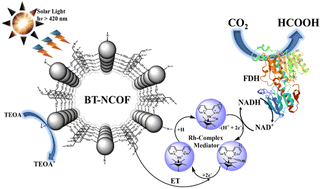
The photocatalytic reduction of carbon dioxide into energy-rich compounds has attracted much attention. However, it is still a challenge to convert CO2 into value-added chemicals by utilizing solar energy. This work reports benzene-1,3,5-tricarbaldehyde (B) coupled with multi-amine linkers (4,4′,4′′-(benzene-1,3,5-triyltris(ethyne-2,1-diyl))trianiline (T)) as a nitrogen-rich covalent organic framework (BT-NCOF). BT-NCOF is afforded as a photocatalyst with highly ordered channels and abundant coordination active sites for small molecule activation. Under solar light irradiation, BT-NCOF acts as an efficient heterogeneous photosystem, utilizing its extended conjugation to use solar photons and drive the selective reduction of CO2 to formic acid while simultaneously promoting NADH regeneration. The optimized BT-NCOF delivers remarkable solar to chemical conversion, achieving NADH regeneration with a yield of 60.34% and a formic acid yield of 157.56 µM. This study demonstrates that nitrogen-rich BT-NCOF can blend light-harvesting, charge-separation, and catalytic functions within a single modular scaffold, offering a robust platform for artificial photosynthesis and sustainable CO2 conversion into solar fuels.
 Please wait while we load your content...


