


 PLATFORM UPDATE:

2D–2D NiMo-LDH/MXene hybrid electrocatalyst for durable and efficient overall water splitting at high current densities

Abstract
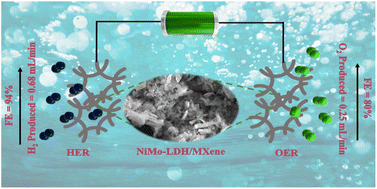
The transition from pilot-scale to grid-scale hydrogen production via water electrolysis requires electrocatalysts that simultaneously exhibit high activity, durability, and scalability. Here, we report a hierarchically engineered two-dimensional (2D–2D) hybrid catalyst comprising NiMo-layered double hydroxide (NiMo-LDH) nanoflowers hydrothermally grown on highly exfoliated MXene nanosheets supported by a porous nickel foam. Scanning electron microscopy reveals an interwoven architecture in which NiMo-LDH nanoflowers are intricately anchored within delaminated MXene layers, effectively suppressing nanosheet restacking and maximizing active site exposure while facilitating rapid gas diffusion. The negatively charged surface terminations of MXene further enhance intrinsic activity by modulating interfacial electronic coupling and optimizing water molecule adsorption on NiMo-LDH. Benefiting from this synergistic design, the NiMo-LDH/MXene hybrid electrocatalyst achieves low overpotentials of 266 mV and 290 mV versus the reversible hydrogen electrode (RHE) at 50 mA cm−2 for the hydrogen evolution reaction (HER) and oxygen evolution reaction (OER), respectively. At higher operational scales, the electrode delivers 200 mA cm−2 at an overpotential of 373 mV for the HER and 320 mV for the OER, underscoring its capability for delivering industrially relevant current densities. The catalyst also exhibits robust long-term durability, sustaining stable operation for nearly 90 h and maintaining highly stable and low potentials of 3.24 V and 4.28 V at industrially relevant current densities of 300 and 1000 mA cm−2, respectively. High faradaic efficiencies of ∼94% for the HER and ∼80% for the OER are simultaneously attained under alkaline conditions. This work highlights the rational integration of layered double hydroxides with conductive 2D materials as an effective route to enhance charge transfer, structural stability, and electrocatalytic efficiency, thereby offering a promising platform for next-generation water-splitting systems aimed at large-scale renewable hydrogen production.
- This article is part of the themed collection: Sustainable Energy & Fuels Recent HOT Articles
 Please wait while we load your content...


