


 PLATFORM UPDATE:

A robust Co/SiO2 catalyst for sustainable sorbitol production: from batch to continuous flow
 *a
*a
Abstract
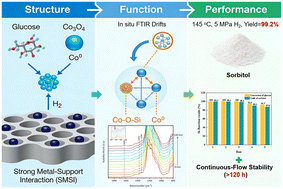
The development of efficient non-noble metal catalysts for glucose hydrogenation to sorbitol is essential for sustainable biomass valorization. Herein, a robust Co/SiO2 catalyst prepared by incipient wetness impregnation is reported. The catalyst with 50 wt% Co loading exhibits a dominant mesoporous structure and moderate metal–support interaction, which stabilizes uniformly dispersed Co3O4 nanoparticles. Under optimized batch conditions (145 °C, 5 MPa H2), complete conversion and a 99.2% sorbitol yield were achieved within 1 h. In situ FTIR DRIFTS reveals a synergistic mechanism wherein Co–O–Si interfacial sites facilitate glucose adsorption and activation, while adjacent metallic Co0 sites provide active hydrogen, effectively suppressing decarbonylation side reactions. The catalyst demonstrated good stability, retaining 88.1% of its initial activity after five cycles. In continuous-flow operation, the catalyst achieved 98.8% conversion with 97.6% yield under optimal conditions, with a gradual decline to approximately 85% conversion after 120 h on stream. This work provides fundamental insights into the structure–activity relationship of Co-based catalysts and demonstrates their potential for industrial sorbitol production, while identifying areas for further improvement in long-term stability.
 Please wait while we load your content...


