


Adsorption-assisted photocatalytic removal of melanoidin from water by a nitrogen-rich covalent organic framework
 a
and
Dan
Zhang
*a
a
and
Dan
Zhang
*a
Abstract
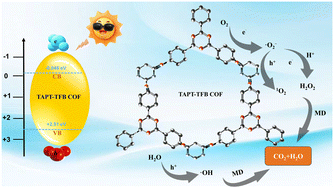
Melanoidin (MD), a refractory macromolecule pollutant common in industrial wastewater, presents significant environmental challenges due to its chemical stability and resistance to biodegradation. In this study, a crystalline covalent organic framework (COF) was synthesized using 2,4,6-tris(4-aminophenyl)-1,3,5-triazine (TAPT) and triformylbenzene (TFB) as building blocks. The resulting TAPT–TFB COF possessed an ordered mesoporous structure, abundant nitrogen-rich active sites, and an extended π–π conjugated framework. These structures featured enhance molecular adsorption and facilitated efficient separation and transport of photogenerated charge carriers, thereby promoting effective MD removal. Notably, 49.5% of MD removal occurred under dark conditions, highlighting the substantial contribution of adsorption. Under simulated irradiation, the TAPT–TFB COF achieved 90.0% MD removal within 90 min, following pseudo-second-order kinetics with the low activation energy of 17.1 kJ mol−1, indicating an adsorption-assisted photocatalytic process. Furthermore, the roles of key reactive species, the influence of coexisting ions, catalyst stability, and performance in real water matrices were systematically evaluated, confirming the TAPT–TFB COF's robustness and practical applicability. This work highlights nitrogen-rich TAPT–TFB COFs as promising, durable adsorption-assisted photocatalysts for effective remediation of refractory organic pollutants, broadening the scope of advanced wastewater treatment technologies.
 Please wait while we load your content...


