


 PLATFORM UPDATE:

Flame-retardant modification of cotton fabrics for aviation safety applications: a study on a phytic acid-chitosan nanocoating based on layer-by-layer self-assembly technology
 *a
*a
Abstract
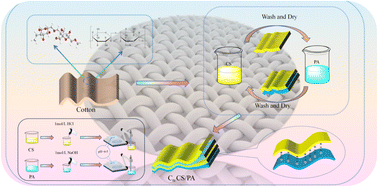
Cotton fabric has found extensive applications in both civilian apparel and aviation interiors, owing to its exceptional breathability, lightweight nature, and design adaptability. Nevertheless, the comfort provided by civil aircraft seat covers is accompanied by intrinsic fire hazards, presenting a significant safety concern. Therefore, the efficient flame-retardant modification of cotton fabrics holds significant research value and application prospects. A layer-by-layer (LbL) self-assembly technique was employed to construct a phosphorus–nitrogen synergistic flame-retardant system on cotton fabric by alternately depositing chitosan (CS) and phytic acid (PA). The uniformity, thermal stability, and flame-retardant performance of the coating were balanced through systematic optimization of key parameters, including CS concentration, PA concentration, dipping time, and number of bilayers. The experimental results indicated a significant enhancement in the thermal stability and flame retardancy of the modified cotton fabrics. Among them, the C10/CS/PA sample exhibited the optimal overall performance, achieving a limiting oxygen index (LOI) of up to 36.2% and an increase in residual char yield of 17.4%. Furthermore, Raman spectroscopy analysis revealed that the ID/IG ratio of the C8/CS/PA sample, with a recorded value of 1.63, was considerably lower than the value of 2.70 for pristine cotton. This confirms that the phosphorus–nitrogen crosslinked network effectively promoted the formation of sp2-hybridized graphitic carbon, leading to the construction of a compact and intumescent char layer, thereby realizing a condensed phase-gas phase synergistic flame-retardant mechanism.
 Please wait while we load your content...


