


Regiodivergent N1- and C3-carboxylation of indoles

Abstract
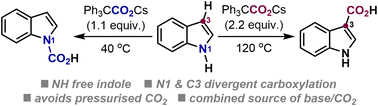
Regioselective carboxylation of indoles using CO2 remains a long-standing challenge, particularly for achieving controllable access to both N1- and C3-carboxylated products under unified conditions. Herein, we report a temperature-controlled, regiodivergent strategy for indole carboxylation enabled by cesium triphenylacetate as a mild CO2-transfer reagent. This metal-free protocol allows selective N1- or C3-carboxylation from the same indole substrates simply by adjusting the reaction temperature and reagent loading, without external CO2 pressure or strong bases. The method exhibits broad substrate scope, predictable regioselectivity, and good functional-group tolerance, and is readily applicable to near-stoichiometric 13C isotope labeling. Mechanistic studies reveal that reversible N1-carboxylation and temperature-dependent redistribution of a delocalized indolyl anion are responsible for the observed regioselectivity. This work establishes a unified and practical platform for regiodivergent indole carboxylation and introduces a distinct CO2-transfer paradigm for regioselective C–H functionalization of heteroarenes.
 Please wait while we load your content...


