


 PLATFORM UPDATE:

Dihydroquinazolinones as photocatalyst-free carbamoyl radical precursors for ynamide formation

Abstract
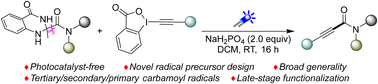
A photocatalyst-free, visible-light-enabled alkynylation of carbamoyl radicals has been developed, facilitating streamlined access to alkynyl amides (ynamides). We use readily prepared carbamoyl-functionalized dihydroquinazolinone precursors, which undergo aromatization-driven C–C bond cleavage after blue light illumination to yield carbamoyl radicals that can be easily trapped by ethynylbenziodoxolone (EBX) reagents. Unlike many carbamoyl-radical alkynylation protocols, this transformation can be easily achieved without additional photocatalysts and can be applied to tertiary, secondary, and primary amide precursors, as well as different arylnyl- and alkylnyl-substituted BI reagents. Synthetic utility is highlighted by the late installation of alkynyl amides at the N-terminus of amino acids and oligopeptides and the derivatization of structurally complex bioactive molecules. Scale-up and the subsequent diversification of terminal ynamides illustrate the practicality of this procedure. Mechanistic studies are consistent with a visible-light-induced radical mechanism involving ground-state EDA complex formation and carbamoyl radical generation.
 Please wait while we load your content...


