Cu(i)-catalyzed 1,2-carbofluorination of unactivated alkenes enabled by N-fluorobenzamides via free radical relay

Abstract

The construction of carbon–fluorine bonds has long been a challenging task. This work presents a two-component 1,2-carbofluorination bifunctionalization of unactivated alkenes via a radical-relay process. N-Fluorobenzamide was employed as a unique carbofluoro-bifunctional reagent that adds across unactivated alkenes, enabling simultaneous formation of C–C and C–F bonds. The reaction proceeds through homolytic cleavage of the N–F bond to generate a nitrogen-centered radical, followed by a 1,5-H atom transfer to produce a remote benzylic carbon radical. This carbon radical adds to the alkene, forming a new alkyl radical, which then undergoes single-electron transfer mediated by an active copper species, ultimately affording a series of β-fluoroamides in moderate yields. Notable features of this transformation include excellent atom economy (with no atom loss), mild reaction conditions and operational simplicity.
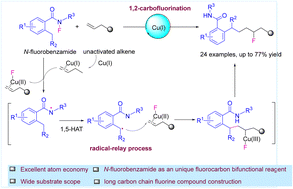
Graphical abstract: Cu(i)-catalyzed 1,2-carbofluorination of unactivated alkenes enabled by N-fluorobenzamides via free radical relay

Supplementary files

Transparent peer review

To support increased transparency, we offer authors the option to publish the peer review history alongside their article.

View this article’s peer review history

Article information

Article type
Research Article
Submitted
02 Jan 2026
Accepted
28 Feb 2026
First published
02 Mar 2026

Org. Chem. Front., 2026, Advance Article

Cu(I)-catalyzed 1,2-carbofluorination of unactivated alkenes enabled by N-fluorobenzamides via free radical relay

H. Ji, H. Qiao, B. Wang, T. Lu, W. Chang, L. Liu and J. Li, Org. Chem. Front., 2026, Advance Article , DOI: 10.1039/D5QO01763G

To request permission to reproduce material from this article, please go to the Copyright Clearance Center request page.

If you are an author contributing to an RSC publication, you do not need to request permission provided correct acknowledgement is given.

If you are the author of this article, you do not need to request permission to reproduce figures and diagrams provided correct acknowledgement is given. If you want to reproduce the whole article in a third-party publication (excluding your thesis/dissertation for which permission is not required) please go to the Copyright Clearance Center request page.

Read more about how to correctly acknowledge RSC content.

Social activity

Spotlight

Advertisements