


Substrate-controlled mechanistic switch between protodemetalation and oxidative addition in Rh-catalyzed carbometalation: a DFT study
 *a
*a
Abstract
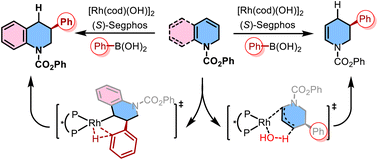
This DFT computational study establishes distinct mechanistic pathways for the Rh(I)-catalyzed carbometalation of dihydropyridines and dihydroquinolines, underpinning their divergent enantioselectivity. For dihydropyridines, the energetically preferred route—comprising alkene insertion, protodemetalation, and transmetalation to yield the S-configured product—is stabilized by a chair-like pyridine ring, as evidenced by NPA charge. The enantioselectivity, controlled at the protodemetalation step, arises from differential distortion energies in the competing transition states. Conversely, dihydroquinolines undergo a modified pathway that includes oxidative addition, bypassing direct protodemetalation due to a destabilizing twist-boat conformation. Here, enantiocontrol is shifted to the reductive elimination step, governed by disparities in key dihedral angles among the transition states.
 Please wait while we load your content...


