


 PLATFORM UPDATE:


Mechanistic insights into PFOS and PFOA adsorption on acid-resistant MgTiO3
 †a
Fumitaka
Hayashi,
ab
Kunio
Yubuta,
a
Eugenio
Otal,
a
Nagahiro
Saito,
cde
Hideki
Tanaka
a
and
Katsuya
Teshima
*ab
†a
Fumitaka
Hayashi,
ab
Kunio
Yubuta,
a
Eugenio
Otal,
a
Nagahiro
Saito,
cde
Hideki
Tanaka
a
and
Katsuya
Teshima
*ab
Abstract
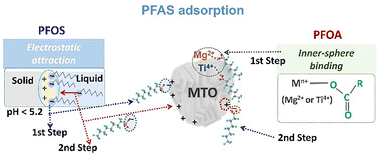
This study explores magnesium titanate (MgTiO3; MTO) as a durable ceramic adsorbent for per- and polyfluoroalkyl substance (PFAS) remediation under extreme acidic conditions. MTO exhibits outstanding acid resistance, retaining its crystal structure even at pH 1.0 with negligible Mg and Ti leaching. At pH 4.5, adsorption isotherms reach saturation, yielding maximum capacities of 8.92 mg g−1 for perfluorooctane sulfonate (PFOS) and 6.42 mg g−1 for perfluorooctanoic acid (PFOA). Adsorption kinetics show rapid uptake, followed by a slower diffusion-controlled regime, with apparent equilibration times of ∼120 min for PFOS and ∼300 min for PFOA. Time-resolved kinetic analyses, including square-root-of-time, pseudo-second-order, and double-exponential models, reveal a characteristic two-stage adsorption process dominated by diffusion resistance. Two-site Langmuir isotherms further support this behaviour by distinguishing high-affinity and non-specific adsorption domains. Spectroscopic analyses elucidate distinct adsorption mechanisms: PFOS adsorbs predominantly via an outer-sphere electrostatic pathway constrained by surface crowding, whereas PFOA undergoes a transition from site-specific inner-sphere coordination at Mg/Ti sites to slower outer-sphere accumulation. These findings demonstrate that PFOS and PFOA exhibit fundamentally different adsorption mechanisms on the same ceramic surface, governed by headgroup chemistry and surface coordination. By integrating exceptional acid durability with mechanistic insight, this work provides a foundation for the rational design of PFAS adsorbents for aggressive industrial wastewater treatment.
 Please wait while we load your content...


