


 PLATFORM UPDATE:


Spatiotemporal identification of therapeutic markers via dual-targeted SERS bioprobes for assessing breast cancer progression

Abstract
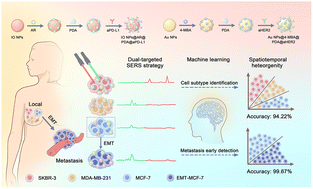
The precise treatment of breast cancer relies heavily on the accurate identification of therapeutic markers. Single surface-enhanced Raman spectroscopy (SERS) bioprobes have been used for primary tumor screening. However, single biomarker detection is insufficient due to tumor heterogeneity and drug resistance during cancer progression. In this study, we developed a dual-targeted SERS sensing platform using IO NPs@AR@PDA@aPD-L1 and Au NPs@4-MBA@PDA@aHER2 bioprobes for the simultaneous detection of dual therapeutic markers (PD-L1 and HER2) in breast cancer, achieving single-cell resolution imaging with a detection limit of 2 cells per mL. Specifically, by digitizing SERS spectra using machine learning, the dual-targeted strategy improved spatial resolution and effectively distinguished the heterogeneous expression of HER2 and PD-L1 in SK-BR-3, MCF-7, and MDA-MB-231 cell lines, improving the detection accuracy by ∼20% compared with single-marker methods. In the temporal dimension, transforming growth factor-β (TGF-β) was used to induce epithelial–mesenchymal transition (EMT) in MCF-7 cells, simulating the highly invasive and metastatic characteristics of advanced tumors, thereby enabling the dynamic monitoring of cancer progression from locally advanced to metastatic disease. This continuous monitoring capability of the dual-targeted strategy offers critical insights into tumor evolution, metastasis risk assessment, and recurrence prediction, thereby playing a vital role in guiding precise cancer management and treatment adaptation.
 Please wait while we load your content...


