


Ni-doped carbon dots unlock dual NIR-II photothermal and photodynamic cancer therapy

Abstract
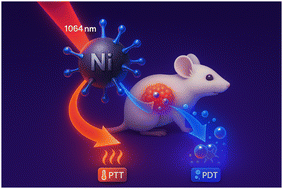
Due to their excellent biocompatibility, outstanding water dispersibility, and multifunctional integration capability, carbon dots have emerged as highly promising materials for cancer phototherapy. In this study, nickel-doped carbon dots (Ni-CDs) were successfully synthesized via a one-step hydrothermal method, which enables efficient and uniform Ni incorporation within the carbon framework. Ni-CDs exhibit strong absorbance in the range of 840–1100 nm. They have a reactive oxygen species (ROS) production rate of 3.27% and a photothermal conversion efficiency of 61.33% under 1064 nm laser irradiation. The enhanced dual-mode performance can be attributed to Ni-induced nonradiative relaxation and improved electron transfer. They are the first reported nickel-doped carbon dots with synergistic therapeutic capabilities of PDT/PTT in the NIR-II region. In vitro and in vivo experiments demonstrated that Ni-CDs can effectively induce tumor cell death, with no significant toxic damage observed in normal tissues/organs. This study highlights the potential of Ni-CDs as a multifunctional nanoplatform for deep-tissue cancer treatment, providing a reference for the design of materials for the synergistic combination of photothermal and photodynamic therapy of deep tumors.
 Please wait while we load your content...


