


 PLATFORM UPDATE:


Demonstration of low-symmetry rhombohedral GeTe single crystals with anisotropic thermoelectric properties

Abstract
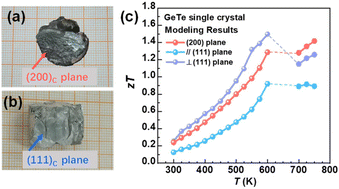
GeTe is a promising thermoelectric material owing to its high electrical performance and low thermal conductivity that originates from its low-symmetry rhombohedral crystal structure with asymmetric Ge–Te bonds. However, experimental studies of its anisotropic properties have been hindered by the lack of large-size single crystals. In this work, large-size GeTe single crystals oriented along the (200) and (111) directions were grown using the Bridgman method. The results show that the (200)-oriented crystal exhibits superior electronic performance to the (111)-oriented one, although electrical transport is weakly anisotropic in both crystals. In contrast, the (111)-oriented crystal exhibits pronounced thermal anisotropy due to its layered structure with alternating Ge–Te bond lengths, whereas the (200)-oriented crystal is nearly isotropic, as confirmed by elastic and Raman measurements. Owing to the low lattice thermal conductivity of the ⊥(111) orientation, modeling indicates that it could surpass the (200) orientation in the low-temperature rhombohedral phase upon further optimization. Conversely, the (200) orientation becomes preferable in the high-temperature cubic regime. These findings underscore the critical role of crystallographic orientation in governing carrier transport and phonon scattering in GeTe, providing guidance for designing high-performance thermoelectric single crystals and other low-symmetry semiconductors.
 Please wait while we load your content...


