


 PLATFORM UPDATE:


Binuclear and trinuclear 3d-metal complexes of HATNA and HAT(CN)6 with unique magnetic behavior: from extremely strong antiferromagnetic coupling to opposite sign of zero-field splitting in the same complex
 a
Denis V.
Korchagin,
a
Akihiro
Otsuka,
d
Hiroshi
Kitagawa
d
and
Dmitri V.
Konarev
*a
a
Denis V.
Korchagin,
a
Akihiro
Otsuka,
d
Hiroshi
Kitagawa
d
and
Dmitri V.
Konarev
*a
Abstract
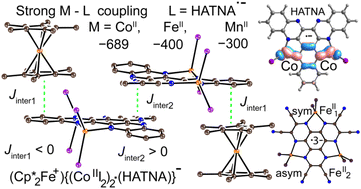
A series of anionic bi- and trinuclear complexes of CoII, FeII and MnII with hexaazatrinaphthylene (HATNA) and hexaazatriphenylenehexacarbonitrile (HAT(CN)6), incorporating paramagnetic Cp*2Fe+ cations (S = 1/2), were obtained. It was demonstrated that even a mild Cp*2Fe reductant can be used to reduce metal complexes of HAT-type ligands. Metal iodides were transferred from the pristine powder to the complexes in a non-coordinating solvent via complex formation with spiropyran or tetrabutylammonium iodide. The isostructural complexes (Cp*2Fe+)[(MIII2)2·HATNA]−·C6H4Cl2·0.5C6H14 (M = Co (1), Fe (2) and Mn (3)) contain monoanionic [(MIII2)2·HATNA]− units, which alternate in π-stacks with Cp*2Fe+ cations and also form π-stacked [(MIII2)2·HATNA−]2 dimers. Metal ion coordination is asymmetric, featuring one short and one long M–N bond. The short M–N bonds are 1.973(6) Å for CoII (1), 2.039(4) Å for FeII (2), and 2.115(4) Å for MnII (3); these are the shortest bonds reported to date among studied HAT-based complexes for CoII and FeII. These complexes exhibit very strong antiferromagnetic metal–radical coupling, which isolates their high-spin ground states at high temperatures. To the best of our knowledge, the exchange coupling value of −300 cm−1 observed for 3 is the highest among MnII-containing complexes based on a radical ligand with delocalized spin. Compound (Cp*2Fe+)[(FeIII2)3·HATNA]−·C6H4Cl2 (4) is unique due to its magnetic behavior, which is severely different from that previously observed for similar trinuclear radical FeII-containing HAT-based complexes. Instead of a smooth increase in the χMT value with a temperature decrease, attributed to the formation of a high-spin system, a rapid increase below 30 K is observed. Trinuclear trianionic species [(FeIII2)3·HAT(CN)6]3− are isolated in (Cp*2Fe+)3[(FeIII2)3·HAT(CN)6]3−·4C6H4Cl2 (5) and do not participate in intermolecular exchange coupling. The unusual magnetic behavior of 5 can only be described by a model implying different signs of D for metal ions in the complex. Such a feature arises from the substantial difference in the coordination geometry of one Fe1 ion compared to the other two Fe2 ions.
 Please wait while we load your content...


