


Constructing dynamic Na+ transport channels in RT Na–S battery separators to suppress polysulfide shuttling and accelerate reaction kinetics
 ab
Maowen
Xu
*ab
ab
Maowen
Xu
*ab
Abstract
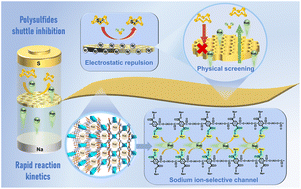
Room-temperature sodium–sulfur batteries (RT Na–S) hold great potential for energy storage due to the abundance of sodium and sulfur, low costs, and high theoretical energy density. However, their development is limited by the shuttle effect of polysulfides, slow reaction kinetics, and the growth of sodium dendrites. These issues lead to rapid capacity decay and poor cycling stability, which are difficult to mitigate using traditional separators. Inspired by ion channels in biological membranes, we developed a carboxylate-modified MIL-121/Na separator. Its sub-nanometer channels enable highly selective Na+ transport with an ionic conductivity of 2.27 × 10⁻⁴ S cm−1, a migration number of 0.74, and a wide electrochemical window of up to 5.1 V. When applied in RT Na–S batteries, it effectively inhibits the polysulfide shuttle and promotes the reaction kinetics, achieving a first-cycle discharge capacity of 1182 mAh g−1 at a 0.5C rate and stable cycling for over 400 cycles, demonstrating excellent rate performance and long cycle life. Even in pouch cells, the performance can be stabilized at a 1C rate for 100 cycles and the cycle-to-cycle stability can be maintained. This study provides a new strategy for separator design to advance high-performance sodium–sulfur batteries.
 Please wait while we load your content...


