


 PLATFORM UPDATE:


Unveiling Li and Sr-induced reinforced transition metal–oxygen interactions in P2-type layered oxide cathodes for highly stable sodium-ion batteries

Abstract
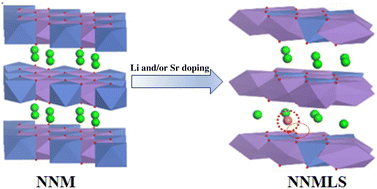
P2–Na0.67Ni0.33Mn0.67O2 has emerged as a promising cathode material for sodium-ion batteries due to its high theoretical specific capacity and excellent air stability. However, this material suffers from two critical bottlenecks: first, it is prone to undergo an irreversible oxygen evolution reaction at a voltage of 4.2 V; second, it experiences significant specific capacity fade under high current density conditions. This work addresses these issues by using a solid-state reaction method to fabricate the Na0.66Sr0.01Ni0.32Li0.01Mn0.67O2 material via co-doping modification with trace amounts of Li and Sr. The research results show that the Li and Sr co-doped material exhibits significant spatially enhanced structural stability at high voltages and effectively suppresses the P2–O2 phase transition. The modified material exhibits superior rate capability (delivering a reversible specific capacity of 62 mA h g−1 at 20 C) and cycling stability (achieving a capacity retention of 87% after 1000 cycles at 10 C). In summary, this Li/Sr synergistic doping strategy provides an effective and straightforward approach for designing layered oxide cathode materials that combine high rate capability with long-term cycling stability.
 Please wait while we load your content...


