


Strategically designed deep-ultraviolet optical crystals with balanced properties by small heteroatom substitution

Abstract
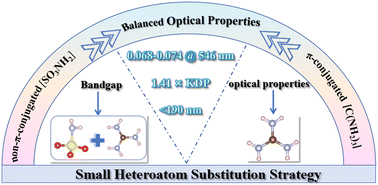
Functional groups are crucial for achieving the balanced properties with a short cutoff edge, moderate birefringence, and strong second-harmonic generation (SHG). Herein, a targeted design strategy integrating small heteroatom-substituted tetrahedral and π-conjugated units was employed. This approach successfully yielded two functionally distinct crystals of C(NH2)3SO3NH2: a birefringent crystal (α-phase: P21/c) and a novel nonlinear optical (NLO) crystal (β-phase: Iba2). These compounds exhibit a short deep-ultraviolet (DUV) cutoff edge (below 190 nm) and suitable birefringence (0.068–0.074@546 nm). Additionally, β-C(NH2)3SO3NH2 possesses a strong SHG response (1.41 × KDP). Functional group analysis reveals that the [C(NH2)3] cation exhibits a dual functionality: its small heteroatom structure widens the band gap, while its π-conjugated framework enhances the birefringence and the SHG response, achieving an optimal balance. This study establishes a generalizable design framework for DUV optical crystals, offering a viable strategy to reconcile the trade-off between key properties.
- This article is part of the themed collection: 2026 Inorganic Chemistry Frontiers HOT Articles
 Please wait while we load your content...


