


In situ integrated construction of electrocatalysts: from microscopic control to macroscopic performance

Abstract
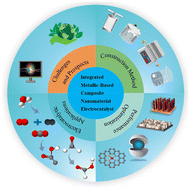
In recent years, in situ generated integrated metal-based composite materials have garnered widespread attention in the field of electrocatalysis due to their advantages such as high reactivity, long lifespan, and rapid electron transfer rates. By employing different synthesis strategies to regulate their structure and composition, the reactivity and selectivity of these materials can be precisely tuned, thereby laying a foundation for designing efficient catalysts tailored for specific reactions. This article systematically reviews the construction methods, regulation strategies, and applications of in situ generated integrated metal-based composite nanocatalysts in various reactions. It also explores the potential of emerging technologies and innovative approaches in material design, performance optimization, and electronic structure modulation. Finally, the main challenges currently facing this field are discussed, along with potential future development directions. Through this comprehensive overview, the aim is to provide valuable insights for advancing the further development of in situ generated integrated metal-based composite nanocatalysts and promoting their widespread deployment in catalytic applications.
- This article is part of the themed collection: 2026 Inorganic Chemistry Frontiers Review-type Articles
 Please wait while we load your content...


