


 PLATFORM UPDATE:


Thermal protocol-driven oxidative etching of ZrC Embedded carbon nanofibers to unlock ZrOxCy nanodomains for selective H2O2 production
 †ab
Soobin
Lee,
†c
Wenjun
Zhang,
e
Min Soo
Kim,
f
Il-Doo
Kim,
f
Wonchang
Choi,
g
Jong Min
Kim,
e
Ki Ro
Yoon
*aci
and
Ji-Won
Jung
*ci
†ab
Soobin
Lee,
†c
Wenjun
Zhang,
e
Min Soo
Kim,
f
Il-Doo
Kim,
f
Wonchang
Choi,
g
Jong Min
Kim,
e
Ki Ro
Yoon
*aci
and
Ji-Won
Jung
*ci
Abstract
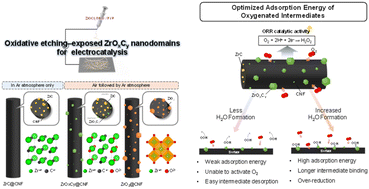
Hydrogen peroxide (H2O2) production via electrochemical two-electron oxygen reduction reaction (2e− ORR) provides a sustainable alternative to conventional synthesis methods. In this study, we develop a protocol-programmed oxidative-etching strategy integrated into an electrospun CNF platform, in which a stepwise air-to-Ar thermal sequence is deliberately designed to reconstruct and expose the near-surface region of confined ZrC into surface-accessible ZrOxCy nanodomains with Zr–O–C interfacial coordination, rather than post-oxidizing bulk ZrC. Controlled thermal protocol for oxidative etching effectively modulated the surface chemistry, mesoporosity, and active site exposure of Zr-based nanodomains at 500 °C. Comprehensive structural and electrochemical analyses demonstrated that the optimized ZrOxCy@CNF catalyst exhibited catalytic activity and selectivity for 2e− ORR based H2O2 generation, achieving approximately 85% selectivity and a mass activity of 8.52 A g−1 at 0.65 V versus RHE. The synergistic combination of exposed ZrOxCy interfacial sites within oxygen vacancies and the electrically conductive one-dimensional CNF backbone facilitated efficient 2e− ORR, enabling low overpotentials and high current densities. These results demonstrate the feasibility of protocol-programmed oxidative etching for tuning selectivity in CNF-supported Zr-based catalysts.
 Please wait while we load your content...


