


Proton conductivity and magnetization photoswitching in CN-bridged Cu II3M IV2 molecules (M = Mo, W) based on carboxy-functionalized macrocyclic ligand

Abstract
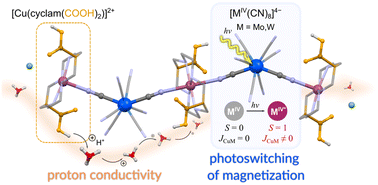
Current efforts in materials science focus on developing efficient solid-state proton conductors for energy production and on achieving light-induced control of material properties at the molecular level. The convergence of these two aspects opens the way to entirely new functionalities. In this context, we present the synthesis, crystal structures, proton conductivity, and photomagnetic effect in two new CN-bridged (H3O)4{[CuII(cyclam(COOH)2)]3[MIV(CN)8]2}Cl2·10H2O coordination complexes (M = MoIV (1), WIV (2)) incorporating dicarboxy-functionalized cyclam (cyclam(COOH)2 = 6,13-dicarboxy-1,4,8,14-tetraazacyclotetradecane). 1 and 2 crystallize in the P![[1 with combining macron]](https://www.rsc.org/images/entities/char_0031_0304.gif) space group, are isostructural, and consist of linear pentanuclear {CuII3MIV2}2− molecules with CuII complexes linked by [MIV(CN)8]4− anions. Due to the presence of protic COOH groups, H3O+ cations, and an extensive network of hydrogen bonds, the compounds 1 and 2 exhibit proton conductivity of 3.88(7) × 10−5 S cm−1 and 1.02(1) × 10−5 S cm−1 (298 K, 95% RH), respectively. Activation energies of 0.49 eV (1) and 0.46 eV (2) suggest that proton relay occurs predominantly along the network of moderate-strength H-bonds according to the Grotthuss mechanism. Both compounds exhibit a photomagnetic response to irradiation with 450 nm light at 10 K, which is attributed to photoinduced transition from singlet (S = 0) to triplet (S = 1) spin-state of MIV centers. The magnetic characteristics of irradiated materials indicate almost complete photoconversion, which activates magnetic superexchange between CuII (S = 1/2) and the photoexcited MIV exhibiting significant zero-field splitting. The coexistence of electrical and switchable magnetic properties in compounds 1 and 2 positions CuII–MIV assemblies as promising platforms for photoswitchable spin-ionics.
space group, are isostructural, and consist of linear pentanuclear {CuII3MIV2}2− molecules with CuII complexes linked by [MIV(CN)8]4− anions. Due to the presence of protic COOH groups, H3O+ cations, and an extensive network of hydrogen bonds, the compounds 1 and 2 exhibit proton conductivity of 3.88(7) × 10−5 S cm−1 and 1.02(1) × 10−5 S cm−1 (298 K, 95% RH), respectively. Activation energies of 0.49 eV (1) and 0.46 eV (2) suggest that proton relay occurs predominantly along the network of moderate-strength H-bonds according to the Grotthuss mechanism. Both compounds exhibit a photomagnetic response to irradiation with 450 nm light at 10 K, which is attributed to photoinduced transition from singlet (S = 0) to triplet (S = 1) spin-state of MIV centers. The magnetic characteristics of irradiated materials indicate almost complete photoconversion, which activates magnetic superexchange between CuII (S = 1/2) and the photoexcited MIV exhibiting significant zero-field splitting. The coexistence of electrical and switchable magnetic properties in compounds 1 and 2 positions CuII–MIV assemblies as promising platforms for photoswitchable spin-ionics.
 Please wait while we load your content...


