


Solvent-mediated synthesis of mesoporous ZnCo-ZIF derived ZnCoNi LDH@MXene for high-performance supercapacitors
 *a
Guang-Sheng
Wang
*b
*a
Guang-Sheng
Wang
*b
Abstract
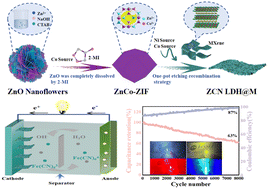
Electrode materials made of supercapacitors have obvious capacity attenuation caused by ion diffusion retardation and insufficient conductivity during high-rate charge and discharge, which seriously restricts the practical application of high-power supercapacitors. In this study, a hierarchical structure of the ZnCoNi LDH@MXene (ZCN LDH@M) electrode material was successfully constructed using a cascade strategy of “solvent-mediated template-etching-recombination”. A rhombic dodecahedron ZnCo-ZIF (50–100 nm) with large mesopores and small size was synthesized on the ZnO nanoflower template, and then ZCN LDH nanosheets were grown in situ on the MXene substrate to obtain petal-shaped ZCN LDH@M composites. Compared with the ZnCoNi LDH electrode (69.1%), the composite showed better performance at a current density of 10 A g−1, and its capacity retention rate reached 77.8%. At the same time, the specific capacitance measured at 1 A g−1 was 1414 F g−1. A high energy density of 45.6 Wh kg−1 was achieved at 750 W kg−1 using the constructed ZCN LDH@M//activated carbon (AC) asymmetric supercapacitor (ASC), which utilized a redox-augmented electrolyte consisting of 6 M KOH + 0.03 M K3[Fe(CN)6]. The unique composition and hierarchical structure of the obtained ZnCoNi LDH@MXene are expected to significantly enhance its electrochemical activity and performance.
 Please wait while we load your content...


