


 PLATFORM UPDATE:


Assembly and solution phase properties of Ag+-mediated adenine–thymine DNA duplexes

Abstract
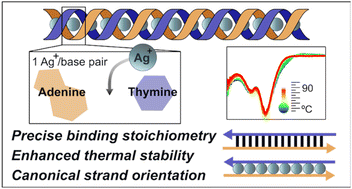
Silver cations (Ag+) exhibit site-specific coordination with the natural nucleobases, which can be exploited within DNA nanostructures. Understanding the thermodynamics of formation and organization of DNA complexes formed by these interactions is essential for rationally designing Ag+-mediated DNA nanostructures. In this study, we use temperature controlled circular dichroism (CD) spectroscopy, isothermal titration calorimetry (ITC), Förster resonance energy transfer (FRET), and cryogenic-transmission electron microscopy (cryo-TEM) to investigate the formation stoichiometry and resulting morphology of Ag+-mediated duplexes of oligo-dA and oligo-dT homonucleotide strands. CD shows that duplex formation occurs at room temperature and is sensitive to solution phase conditions. ITC reveals that 0.5 [Ag+]/[base] is required to form thermodynamically stable dA–Ag+–dT structures with one Ag+ per base pair. FRET experiments show that dA–Ag+–dT duplexes maintain anti-parallel strand orientation, even with excess Ag+, and cryo-TEM shows that dA–Ag+–dT duplexes adopt morphologies similar to WCF duplexes. Despite these similarities, dA–Ag+–dT duplexes exhibit significantly greater thermal stability compared to their WCF counterparts. These findings provide new insights into dA–Ag+–dT duplex formation and structure that are essential for the development of programmable Ag+–DNA nanostructures.
- This article is part of the themed collection: Inorganic Chemistry Frontiers Emerging Investigator Series 2024–2025
 Please wait while we load your content...


