


A highly efficient extraction system for Am(iii)–Cm(iii) pair separation in spent nuclear fuel reprocessing
 *a
P. I.
Matveev,
a
V. G.
Nenajdenko,
a
Yu. A.
Ustynyuk,
a
M. V.
Evsiunina,
a
P. S.
Lemport,
a
V. S.
Petrov,
a
A. D.
Krot,
a
V. N.
Khrustalev,
cd
*a
P. I.
Matveev,
a
V. G.
Nenajdenko,
a
Yu. A.
Ustynyuk,
a
M. V.
Evsiunina,
a
P. S.
Lemport,
a
V. S.
Petrov,
a
A. D.
Krot,
a
V. N.
Khrustalev,
cd
Abstract
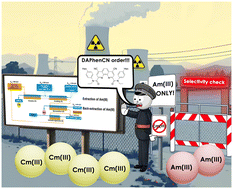
Closing the nuclear fuel cycle is a key objective in the development of Generation IV nuclear systems, enabling the recycling of actinides and reducing the long-term radiotoxicity of nuclear waste. Americium is a prime candidate for transmutation, but its effective use requires high-purity separation from chemically similar curium and lanthanides. In this work, we report the design, synthesis, and evaluation of a novel extractant, 4,7-dicyano-N,N′-diethyl-N,N′-diphenyl-1,10-phenanthroline-2,9-dicarboxamide (DAPhenCN), for selective separation of Am(III) from Cm(III). This extractant was selected for synthesis based on the DFT modeling results of the complexes of 4- and 7-disubstituted 1,10-phenanthroline-2,9-dicarboxamides with Am(III), Cm(III) and lanthanides(III). Solvent extraction experiments revealed Am/Cm separation factors (SFAm/Cm) of 5–6, with favorable distribution ratios for counter-current processing. Crucially, DAPhenCN demonstrated excellent resistance to hydrolysis and radiolysis under α-, γ-, and electron-beam irradiation. Counter-current tests using real raffinates from VVER-1000 spent nuclear fuel reprocessing confirmed the robustness and efficiency of the extraction system, achieving >99% americium recovery and >99.9% curium purity. Light lanthanides partially co-extracted with Am(III), while heavier ones had no significant impact. The developed process enables the production of curium-free americium suitable for transmutation fuel fabrication, advancing the implementation of closed nuclear fuel cycles.
 Please wait while we load your content...


