


Heat-resistant poly(methyl methacrylate) by modification with perfluorocyclobutyl methacrylamide monomers
 *a
*a
Abstract
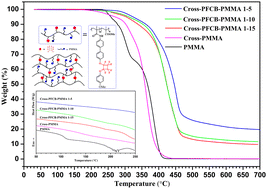
Poly(methyl methacrylate) (PMMA) is widely studied for its attractive properties, including good processability, excellent optical characteristics and low cost. Nevertheless, a persistent challenge for PMMA-based materials is their limited thermal stability. Herein, a series of PMMA copolymers containing perfluorocyclobutyl (PFCB) aryl ether groups were prepared to enhance the heat resistance of PMMA-based materials via the introduction of rigid PFCB aryl ether moieties and the formation of a cross-linked network. PFCBMA, a methacrylamide monomer containing a PFCB aryl ether moiety, was first synthesized and copolymerized with MMA to afford PFCB-containing PMMA copolymers (PPFCBMA-co-PMMA), which exhibit higher glass transition (Tg) and thermal decomposition (Td) temperatures than PMMA. Subsequently, a dimethacrylamide monomer bearing a PFCB aryl ether moiety (MAPFCBMA) was synthesized and copolymerized with MMA to afford crosslinked PMMA copolymers (cross-PFCB-PMMA) with PFCB units serving as crosslinking points. These cross-PFCB-PMMA polymers show much higher thermal decomposition temperatures than pure PMMA and PPFCBMA-co-PMMA. Furthermore, no glass transition was observed below 250 °C in DSC analysis of cross-PFCB-PMMA polymers. This work demonstrates that incorporating PFCB aryl ether moieties, introducing amide bonds and constructing a crosslinked network are effective strategies for improving the thermal stability of PMMA-based polymers.
 Please wait while we load your content...


