


 PLATFORM UPDATE:


Cooperative triple catalysis for complex molecule construction and late-stage functionalization

Abstract
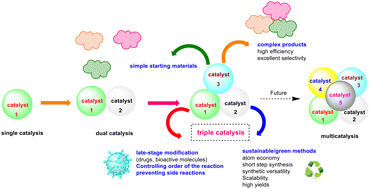
The recent development of modern catalysis has transformed synthetic chemistry by enabling highly efficient, selective, and sustainable C–C, C–N, C–O, and C–HA bond-forming processes. Among these innovations, triple catalysis the synergistic merger of three distinct catalytic cycles has emerged as a powerful strategy for addressing long-standing challenges in reactivity and chemo, regio and enantioselectivity. By merging photoredox catalysis, transition-metal catalysis, organocatalysis, or hydrogen atom transfer (HAT) cycles within a single reaction process, triple catalysis permits rapid access to previously unattainable transformations under mild or sustainable conditions. Such cooperative catalytic systems not only expand the chemical space by enabling unconventional bond constructions but also significantly improve reaction efficiency, broader substrate scope, and sensitive functional-group tolerance. This review provides a comprehensive overview of the design catalysts, mechanistic information, new molecule constructions and synthetic applications of the triple catalytic framework. This work covered recent advances in cross-coupling reactions, C–H functionalization, asymmetric synthesis, complex molecule construction, and late-stage functionalization of drugs and natural products. Triple catalysis represents a frontier strategy that demonstrates how cooperative catalytic systems can reshape synthetic methodologies and drive the next generation of drug discovery and materials science developments.
 Please wait while we load your content...


