


Sulfonated, sulfated thioglycosides and multivalence in heparanase inhibition
 *a
and
Vincent
Chagnault
*a
*a
and
Vincent
Chagnault
*a
Abstract
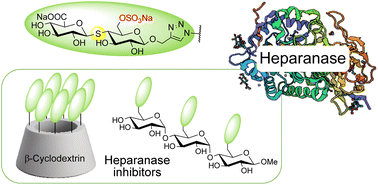
Heparan sulfate (HS) analogs are synthetic oligo- and polysaccharides designed to mimic or enhance several biological properties of native HS. Organic synthesized compounds are very useful tools for understanding the structure–activity relationships of many biological events. Unlike heterogeneous mixtures of tissue-isolated biomolecules, synthetic compounds offer a valuable platform to probe structure–activity relationships with reduced off-target effects in pharmacological applications. In our research group, we are particularly focused on the design and synthesis of thiodisaccharide analogs mimicking HS structural motifs. In recently published work, we reported the synthesis and biological evaluation of both new sulfated and non-sulfated O- and S-linked disaccharides, demonstrating their potential as heparanase inhibitors. In this article, we introduced a sulfonate moiety as a stable analog of the sulfate group. Comparative heparanase inhibition assays reveal that sulfated disaccharides exhibit significantly greater activity than their sulfonated counterparts. Furthermore, multivalent glycoclusters were prepared by coupling sulfated thiodisaccharides to maltotriose and cyclodextrin scaffolds, providing novel molecular architectures that show promising heparanase inhibition.
 Please wait while we load your content...


