


 PLATFORM UPDATE:


Moderate Ce doping enables outstanding oxygen evolution activity and stability in CoMn-LDH nanosheets

Abstract
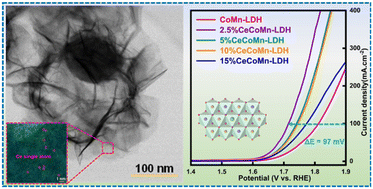
The development of efficient and durable non-precious electrocatalysts for the oxygen evolution reaction (OER) remains a critical challenge for sustainable hydrogen production via water electrolysis. In this work, a series of Ce-doped CoMn-layered double hydroxide (CM-LDH-Ce) nanosheets are synthesized through a solvothermal approach, with the Ce content systematically tuned from 0 to 15 at%. Comprehensive characterization indicates that moderate Ce doping (2.5 at%) promotes the formation of a well-defined core–shell nanoarchitecture, enlarges the electrochemically active surface area, modulates the electronic structures of Co and Mn, and introduces beneficial oxygen vacancies. These integrated structural and electronic modifications lead to exceptional OER activity in alkaline medium. The optimized CM-LDH-Ce2.5 catalyst exhibits a low overpotential of 287 mV at 10 mA cm−2, requires an overpotential of 500 mV to achieve 500 mA cm−2, shows a small Tafel slope of 87.12 mV dec−1, and demonstrates remarkable stability over 100 h of continuous operation. In contrast, excessive Ce addition (≥10 at%) disrupts the layered ordering and causes severe activity degradation. This study establishes a clear dopant-dependent relationship between structural integrity and electrocatalytic function, offering a rational design strategy for high-performance LDH-based OER electrocatalysts via controlled rare-earth engineering.
 Please wait while we load your content...


