


 PLATFORM UPDATE:


Engineering layered double hydroxides for photochemical and electrochemical hydrogen evolution: mechanistic insights and structure–property relationships
 b
and
Tokeer
Ahmad
*a
b
and
Tokeer
Ahmad
*a
Abstract
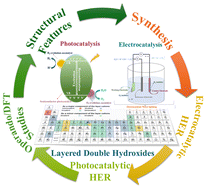
As a multifaceted class of 2D materials, layered double hydroxides possess great potential for the hydrogen evolution reaction. LDHs have a lamellar structure, defect-rich framework, and adjustable cation composition that are active in tuning their electronic structures and reaction interfaces to facilitate proton adsorption. This work surveys recent developments in comprehending the structure–activity relationships of LDHs in accordance with photochemical and electrochemical HER processes. The roles of lattice architecture, interlayer anions, and cation interactions in controlling charge migration, active site attainability, and adsorption energetics are emphasized in this work. Chemical strategies to alter the catalytic efficacy of LDH-based materials toward the HER are scrutinized, including heterostructure design, strain engineering, elemental doping, and interface adjustments. The catalytic mechanism of LDH-based catalysts in the light of theoretical modelling and operando/in situ characterization studies is discussed in detail. This review will be a torchbearer in bridging the gap between heterogeneous catalysis and LDH catalytic systems and will guide researchers to engineer high-performing LDH-derived HER catalysts.
- This article is part of the themed collection: Recent Review Articles
 Please wait while we load your content...


