


 PLATFORM UPDATE:


Microstructure-regulated V2O3 cathodes for high-rate and durable aqueous zinc-ion batteries
 *bc
*bc
Abstract
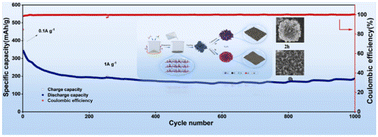
Vanadium(III) oxide (V2O3) has emerged as a promising cathode material for aqueous zinc-ion batteries owing to its high theoretical capacity based on reversible two-electron redox chemistry. However, the cycling stability and reaction kinetics are highly sensitive to its microstructural characteristics, which remain insufficiently understood. Here, we report a facile and scalable synthesis of V2O3via combining an oil-bath reaction and a controlled calcination process, enabling precise regulation of particle morphology and microstructure through calcination time. Systematic microstructural evolution is correlated with zinc-ion storage behavior, revealing that optimized architectures effectively promote ion transport kinetics and structural stability. Coupled with a high-concentration water-in-salt electrolyte to suppress parasitic reactions, the optimized V2O3 cathode delivers a high specific capacity of 453.8 mAh g−1 at 0.05 A g−1, exceptional rate capability with 180 mAh g−1 retained at 10 A g−1, and prolonged cycling stability of 210 mAh g−1 after 1000 cycles at 1 A g−1. This work elucidates the underlying structure–property relationship governed by the microstructure and also provides valuable insights into the design of high-performance cathode materials for advanced energy storage systems.
 Please wait while we load your content...


