


Electrochemically derived nanoporous Bi from plasma-structured BiOCl for high-efficiency CO2 electroreduction

Abstract
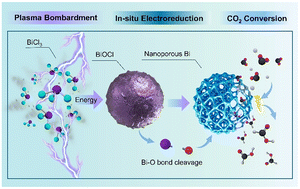
Controlled phase evolution in catalytic architecture design remains challenging for selective CO2-to-formate conversion using non-precious metals. We present a sequential plasma-electrochemical strategy converting BiOCl precursors into nanoporous Bi networks. Plasma treatment of BiCl3–C yields metastable BiOCl with atomic disorder and mesopores; subsequent electrochemical activation reconstructs it into interconnected Bi nanoporous structures (20–50 nm pores) for efficient CO2 reduction. The catalyst affords 93.4% formate faradaic efficiency at 300 mA cm−2, >90% selectivity over 100–500 mA cm−2, and only 4.7% FE loss in 40 h—outperforming thermal Bi catalysts by ∼13.3 points in retention. Operando spectroscopy and simulations show plasma-induced lattice distortions lower the reconstruction barrier, creating electric field-enhanced porous Bi that concentrates K+ and stabilizes *OCHO−, promoting formate while suppressing HER. This work establishes a paradigm for metastable electrocatalyst design via coupled non-equilibrium synthesis and electrochemical reconstruction, enabling scalable CO2 conversion at industrially relevant currents.
 Please wait while we load your content...


