


 PLATFORM UPDATE:


Improving the performance of a triboelectric nanogenerator by tuning the work function of a surface modified tribonegative polymer composite
 *ac
and
Sukhen
Das
*a
*ac
and
Sukhen
Das
*a
Abstract
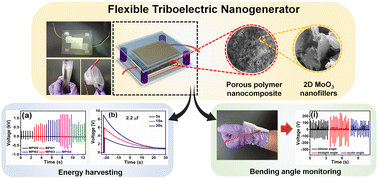
Performance of a triboelectric nanogenerator (TENG) is influenced by numerous parameters including device structure, surface charge density, and contact area of the contacting surfaces. Here, we have modified the polarization and surface porosity of a ferroelectric polymer nanocomposite and used it as a tribonegative material to tune the output performance of a vertical contact–separation TENG. 2D MoO3 nanoflakes were used as the nanofiller in the ferroelectric poly(vinylidene fluoride-co-hexafluoropropylene) (PVDF-HFP) polymer to enhance the β phase polarization of the novel nanocomposite film. Additionally, the facile phase inversion (PI) method is optimized to fabricate the nanoporous composite film. The success of this two-fold strategy is confirmed by Kelvin probe force microscopy and work function studies. The use of a 3 wt% MoO3/PVDF-HFP PI-composite results in ∼200% higher output voltage of the TENG (1100 V, power density ∼8.08 W m−2) than the traditional solution-cast composite film. The fabricated TENG exhibits quick charging of capacitors and powering of LEDs as practical applications. Furthermore, this high-performance TENG is used as a bending angle sensor due to the device's excellent flexibility. The device is capable of generating distinct output voltages at different bending angles and is thus found suitable for monitoring joint movements in the human body.
 Please wait while we load your content...


