Enhancing crystallization and mechanical properties of PET polyester using functionalized carbon nanotubes

Abstract

This study presents an innovative electrochemical peeling–APTES silanization synergistic strategy for the preparation of a CNT–APTES nucleating agent that effectively integrates rigidity and flexibility. The electrochemical process selectively removes the outer wall of CNTs while preserving the integrity of the sp2 carbon skeleton, resulting in efficient silanization of CNTs and a reduction in the reaction time of traditional processes by 72%. When the amount of this nucleating agent is 0.6 wt%, the tensile strength of the PET composite material increases from 53.13 MPa to 86.3 MPa, representing a relative increase of 48.3%. Additionally, the crystallization half-life is shortened by 38.8%, while the elongation at break remains at 1680%, achieving a synergistic optimization of crystallization performance and mechanical properties. In conclusion, the CNTs–APTES synthesized through this synergistic strategy can serve as an effective nucleating agent for polyethylene terephthalate (PET).
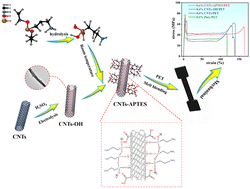
Graphical abstract: Enhancing crystallization and mechanical properties of PET polyester using functionalized carbon nanotubes

Supplementary files

Transparent peer review

To support increased transparency, we offer authors the option to publish the peer review history alongside their article.

View this article’s peer review history

Article information

Article type
Paper
Submitted
26 Dec 2025
Accepted
18 Mar 2026
First published
14 Apr 2026

Nanoscale, 2026, Advance Article

Enhancing crystallization and mechanical properties of PET polyester using functionalized carbon nanotubes

P. Zhang, Y. Wang, M. Zhang, L. Huang, K. Li, F. Li, W. Wang and J. Tang, Nanoscale, 2026, Advance Article , DOI: 10.1039/D5NR05456G

To request permission to reproduce material from this article, please go to the Copyright Clearance Center request page.

If you are an author contributing to an RSC publication, you do not need to request permission provided correct acknowledgement is given.

If you are the author of this article, you do not need to request permission to reproduce figures and diagrams provided correct acknowledgement is given. If you want to reproduce the whole article in a third-party publication (excluding your thesis/dissertation for which permission is not required) please go to the Copyright Clearance Center request page.

Read more about how to correctly acknowledge RSC content.

Social activity

Spotlight

Advertisements