


 PLATFORM UPDATE:


Carbon-layer-encapsulated MOF-derived CoS2 for enhanced sodium-ion storage

Abstract
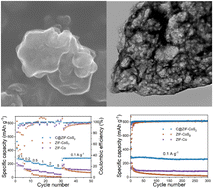
Transition metal sulfides have emerged as promising anode materials for sodium-ion batteries (SIBs) owing to their high theoretical capacities. However, their practical application is hindered by rapid capacity degradation, primarily attributed to polysulfide shuttling and structural collapse. In this study, we present a dual-modification approach for addressing these challenges by synthesizing cobalt disulfide (CoS2) derived from ZIF-67 and encapsulating it within a conductive nitrogen-doped carbon matrix (denoted as C@ZIF-CoS2). The inner carbon framework, originating from the ZIF precursor, facilitates uniform dispersion of CoS2 nanoparticles and mitigates volume expansion during cycling. Concurrently, the outer carbon layer, derived from polydopamine, effectively inhibits polysulfide dissolution and enhances electrical conductivity. Electrochemical evaluation of the C@ZIF-CoS2 electrode demonstrates excellent cycling stability, exhibiting a reversible capacity of 262.5 mAh g−1 after 300 cycles at a current density of 0.1 A g−1 with 93.1% capacity retention and 185.2 mAh g−1 after 1000 cycles at 1 A g−1 with 95.7% retention. Kinetic analyses indicate a predominant pseudocapacitive behavior, accompanied by improved sodium-ion diffusion kinetics. This work offers a straightforward and efficient strategy to stabilize metal sulfide anodes, advancing the development of high-performance sodium-ion batteries.
 Please wait while we load your content...


