


Substrate-driven modulation of interfacial charge transfer dynamics in cobalt phthalocyanine–2D material van der Waals heterostructures

Abstract
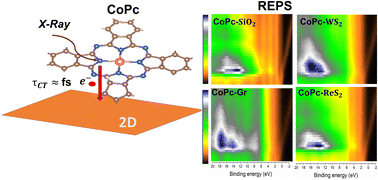
The substrate-driven modulation of interfacial charge transfer in redox-active cobalt phthalocyanine (CoPc)–two-dimensional (2D) material heterostructures was investigated using Raman spectroscopy, X-ray photoelectron spectroscopy (XPS), near-edge X-ray absorption fine structure (NEXAFS), and resonant photoemission spectroscopy (RPES). Graphene (Gr), tungsten disulfide (WS2), and rhenium disulfide (ReS2) were selected as representative 2D substrates with distinct electronic structures and morphologies. Raman mapping confirmed the formation of vertically stacked CoPc–2D architectures. The broadening of the 2D-layer Raman modes evidences interfacial charge transfer that enhances electron–phonon scattering, most pronounced in CoPc–Gr, consistent with stronger molecule–substrate coupling. XPS analysis highlights the key role of Co–N(pyrrole) species in mediating electronic interactions. Polarization-dependent N K-edge NEXAFS reveals a preferential edge-on molecular orientation, attributed to the surface roughness of the 2D materials. Charge-transfer dynamics, quantified using the core-hole clock method, were investigated for CoPc on Gr, WS2, and ReS2, showing clear substrate dependence. Charge transfer during the N 1s core-hole lifetime occurs for electrons excited into both LUMO and LUMO+1 states, with the fastest transfer observed for CoPc–Gr (τCT ≈ 14 and 9 fs), due to the strong coupling between CoPc LUMOs and graphene π states. A similar but weaker interaction with WS2 d states also promotes efficient transfer, whereas in CoPc–ReS2, the reduced orbital overlap arising from the in-plane anisotropy of ReS2 leads to longer τCT values. These findings provide mechanistic insight into substrate-governed charge-transfer processes in organic–2D hybrid systems, offering valuable guidance for the design of next-generation optoelectronic devices.
- This article is part of the themed collection: 2026 Nanoscale HOT Article Collection
 Please wait while we load your content...


