


Controlled construction of nanodisk dimer-over-mirror for near-field enhancement and linewidth shrinking

Abstract
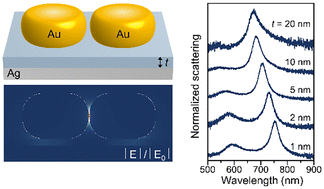
Nanoparticle-over-mirror (NPOM) is a widely used plasmonic nanocavity design for enhanced spectroscopy, light harvesting, and sensing. However, it is isotropic in the mirror plane and exhibits only weak in-plane local field enhancement, limiting its coupling to in-plane optical transitions or other polarization-sensitive applications. Here, we fabricated and characterized a novel nanodisk dimer-over-mirror design that combines the merits of a plasmonic dimer and NPOM, i.e., strong in-plane near-field enhancement, narrow linewidth, strong polarization anisotropy, and directional emission. Compared with a single nanodisk-over-mirror, the lowest energy plasmon mode in such a film-coupled nanodisk dimer shows 24.8 (3.8) times larger scattering (absorption) cross section and supports two orders of magnitude stronger in-plane electric field enhancement. Compared with a nanodisk dimer on a dielectric substrate, the presence of a mirror can compress the linewidth and finely red-shift the resonance wavelength as the spacer thickness reduces. In addition, quantum-corrected electromagnetic modeling suggests that the quantum-mechanical effect of the vertical gap between the nanodisk and the film has a much stronger influence on the plasmon resonance than that of the horizontal gap between adjacent nanodisks, because of the larger contact area. The film-coupled nanodisk dimer offers a customizable plasmonic interface for Purcell-enhanced photon emissions and single-molecule vibrational spectroscopy.
 Please wait while we load your content...


