


Enhancing the electrocatalytic potential of trimetallic CeSmGd-MOFs for oxygen evolution reaction, supercapacitor, and dye degradation applications
 *a
Muhammad
Tariq,
a
Hafiz Muhammad
Asif,
a
Muhammad
Ali Khan,
a
Muhammad
Hanif,
*c
Aysha
Arshad
a
and
*a
Muhammad
Tariq,
a
Hafiz Muhammad
Asif,
a
Muhammad
Ali Khan,
a
Muhammad
Hanif,
*c
Aysha
Arshad
a
and
Abstract
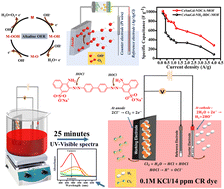
Developing multifunctional materials exhibiting high electrocatalytic activity, superior energy storage capability, and excellent pollutant degradation efficiency is highly desirable for advancing sustainable energy and environmental technologies. A novel approach to fabricate two different trimetallic metal–organic frameworks by a solvothermal method was developed. The synergistic effect of cerium, samarium, and gadolinium with two different organic ligands, namely, 2-NH2-1,4-benzene dicarboxylic acid and 2,6-naphthalene dicarboxylic acid, was assessed. The rod-like MOFs were further investigated by electrochemical analysis for applications in the oxygen evolution reaction (OER), supercapacitors, and Congo red dye degradation. For the OER, the CeSmGd-NDCA-MOF and CeSmGd-NH2-BDC-MOF exhibited overpotentials of 188 and 214 mV, respectively, along with Tafel slopes of 57 and 61 mV dec−1, respectively, at a current density of 10 mA cm−2. The enhanced electrocatalytic OER performance of the CeSmGd-NDCA-MOF was attributed to its high electrochemical surface area of 1837.5 cm2, resulting in a low charge transfer resistance of 2.94 Ω cm−2 and an enhanced conductivity of 2.04 Ω−1 cm−1. Furthermore, supercapattery analysis of the CeSmGd-NDCA-MOF and CeSmGd-NH2-BDC-MOF revealed that the former exhibited better activity, with a specific capacitance of 697.8 F g−1 at a scan rate of 5 mV s−1 and 771.4 F g−1 at a current density of 1 A g−1, as calculated from CV and GCD, respectively, in 1 M KOH. A CeSmGd-NDCA-MOF-based two-electrode device was fabricated, and it delivered an energy density of 11.65 Wh kg−1 and a power density of 500 W kg−1 at 1 A g−1. The assembled device revealed a capacitance retention of 94.54% at 100 mV s−1 and a coulombic efficiency of 100% for 1500 cycles of galvanostatic charge and discharge. For electrochemical CR degradation, the CeSmGd-NDCA-MOF revealed an efficiency of 95.23% at an applied potential of 0.1 V after 25 min (at pH 7, at 14 ppm CR concentration, and in 0.1 M KCl electrolyte) with an energy consumption of 8.89 × 10⁻⁴ kWh m−3 and an estimated cost of $4.30 × 10⁻⁵.
 Please wait while we load your content...


