


Mechanistic insights into crossover-dependent nuclease resistance of PX vs. dsDNA using enhanced sampling

Abstract
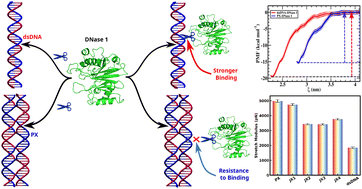
Designing biostable DNA nanocarriers for targeted therapeutic delivery remains a key challenge in DNA nanotechnology due to their susceptibility to nuclease degradation. Multi-stranded DNA nanostructures, such as paranemic crossover (PX–DNA), exhibit significantly enhanced biostability compared to native dsDNA, owing to their unique crossover-dependent topological features. However, a complete molecular understanding of the mechanism behind this exceptional nuclease resistance of PX–DNA nanostructures is still lacking. In this study, we use atomistic molecular dynamics simulations to investigate the interaction behaviour of DNase I nuclease and uncover the molecular origin of the enhanced resistance exhibited by crossover-rich PX–DNA compared to native dsDNA. Our simulation results reveal that the six crossover points in PX–DNA induce an over-twisted (∼35°) helix and narrower minor grooves, reducing DNase I binding affinity (i.e., ∼+5 kcal mol−1 for PX–DNA vs. ∼−17 kcal mol−1 for dsDNA). The stretch modulus (γG) calculations further confirm enhanced mechanical stiffness of PX–DNA (∼4804 pN) compared to that of dsDNA (∼1845 pN). These findings highlight how strategically positioned crossover sites can significantly modulate DNA stability against nuclease degradation at the nanoscale, offering a molecular framework for designing robust, biostable DNA nanostructures for targeted therapeutic delivery applications.
 Please wait while we load your content...


