


 PLATFORM UPDATE:


Two-dimensional conducting polymers: synthetic strategies and emerging applications in sensor technologies
 *b
*b
Abstract
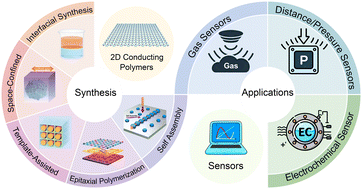
Two-dimensional conducting polymers (2DCPs) are characterized by suppressed chain entanglement and interchain disorder, enabling continuous in-plane charge transport, enhanced specific surface area, and retained mechanical compliance. This review provides a structured overview of interfacial synthesis, space-confined growth, template-assisted synthesis, epitaxial polymerization, and self-assembly. The focus is placed on their mechanisms for achieving precise thickness control, high crystallinity, and long-range order. Interfacial routes (air/liquid, liquid/liquid, solid/liquid, and quasi-liquid ice layers) afford monolayer-to-multilayer films with diffusion-limited crystallization and wafer-scale continuity, while surfactant monolayers enforce pre-organization. Space confinement within layered hosts (FeOCl, MXenes, layered double hydroxides, and montmorillonite) acts as 2D nanoreactors to direct intercalation, chain alignment, and lamellar superlattices. Template-assisted approaches program pore architecture and lateral order using hard/soft templates and vapor routes. Epitaxial strategies on graphene and MnOx templates leverage lattice matching, π–π stacking, and interfacial bonding to planarize backbones. Moreover, acid-modulated self-assembly unlocks free-standing PEDOT:PSS nanosheets with enhanced order and stiffness. These structural controls translate into sensor performance. Gas sensors achieve 10 ppt NH3 detection with fast responses. Pressure/distance devices exploit quasi-2D anisotropy for high sensitivity and stability. Electrochemical platforms deliver broad linear ranges and low detection limits, including chiral recognition and enzyme-free detection. Leveraging the unique combination of intrinsic in-plane charge transport, molecular programmability, and mechanical compliance, 2DCPs are poised to serve as foundational materials for next-generation flexible and bio-integrated sensors. In particular, these materials enable miniaturized, low-noise, and energy-efficient platforms for healthcare monitoring, human–machine interfaces, and distributed environmental sensing.
- This article is part of the themed collection: Recent Review Articles
 Please wait while we load your content...


