


Plasmon-mediated N-dealkylation instead of chiral discrimination of the drug propranolol adsorbed on gold nanoparticles

Abstract
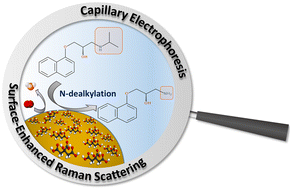
Detailed knowledge and a deep understanding of the surface processes occurring on plasmonic substrates under local electromagnetic fields are essential for further research and the development of their applications. This is especially relevant to interface phenomena involving gold nanoparticles and bioactive molecules, especially when such systems are intended for use with living cells or the human body. Here, a comprehensive study of the adsorption of beta-blockers (propranolol, carvedilol, and amlodipine) on bare and modified gold nanoparticles is presented. Surface-enhanced Raman scattering and capillary electrophoresis were used to study the gold surface and the solution above at different times during drug adsorption. It was observed that N-dealkylation occurs when propranolol molecules are adsorbed on uncoated gold nanoparticles, and the reaction product was confirmed by high-performance liquid chromatography coupled with high-resolution mass spectrometry. The study of propranolol adsorption under argon bubbling and in the presence of a singlet oxygen scavenger demonstrated that gold nanoparticles promote the formation of reactive oxygen species, which play a key role in oxidation. The mechanism of propranolol surface N-dealkylation is proposed based on comprehensive experimental and literature data analysis. The revealed plasmon-assisted reaction may have important implications for further use of gold nanoparticles in bioanalysis and medicine.
 Please wait while we load your content...


