


Multiscale simulation of eco-friendly perovskites under space radiation
 *ab
*ab
Abstract
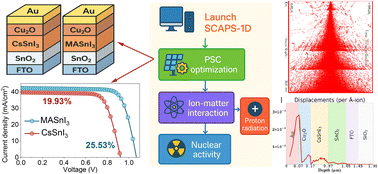
As continuing advancements push hybrid organic–inorganic perovskite solar cells (PSCs) towards commercialization for terrestrial photovoltaic (PV) conversion, attention is concurrently increasing for extraterrestrial applications. PSCs as a space PV technology have the promise of light weight, low cost, mechanical flexibility, high specific power, and radiation tolerance. Still, to be an affordable space technology, the complete PSC structure must withstand the severe radiation environments in space. Herein, we design lead-free tin-based PSCs using methylammonium tin iodide (MASnI3) and cesium tin triiodide (CsSnI3) as light absorption layers. The photoelectric properties of MASnI3- and CsSnI3-based PSCs were analyzed in detail using Solar Cell Capacitance Simulator (SCAPS-1D) software. Following optimization, we found that the MASnI3 device achieves a superior power conversion efficiency (PCE) of 25.53%, exceeding the 19.93% performance of the CsSnI3 device under the AM0 solar spectrum. Importantly, our results show that the all-inorganic CsSnI3-based PSC can resist thermal stress at high temperatures, while the MASnI3-based PSC suffers from a performance drop. We identify that the performance degradation arises primarily from the increased recombination and carrier trapping in the MASnI3 perovskite layer. Interestingly, a significant correlation was observed between the SRIM/TRIM-predicted radiation damage profiles and the SCAPS-derived PV performance, both of which suggest that the CsSnI3-based devices show superior radiation tolerance and thermal stability due to a lower number of displaced atoms under proton irradiation. Using TALYS 2.0, we calculated the cross-sections and radioactivities of the isotopes produced by the interaction of protons with the solar cell layers. The results showed the formation of a number of stable and radioactive isotopes as a result of this irradiation, but the radioactivity levels were very low and did not pose any significant threat.
 Please wait while we load your content...


