


 PLATFORM UPDATE:

SCAPS-1D design and performance optimization of lead-free bilayer perovskite solar cells with Sr3SbI3/Mg3AsBr3 absorbers and a SrCu2O2 hole-transport layer
 a
Yongmao
Hu
a
a
Yongmao
Hu
a
Abstract
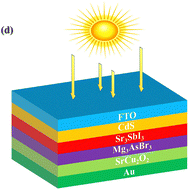
To improve the photovoltaic performance of Pb-free A3BX3 halide-perovskite solar cells, four planar device architectures were designed and optimized using SCAPS-1D with Sr3SbI3 and Mg3AsBr3 as absorber materials. Different hole-transport-layer materials were further evaluated, and SrCu2O2 was identified as the most favorable HTL owing to its improved band alignment and carrier-extraction capability. Under the adopted simulation conditions, the single-absorber devices FTO/CdS/Sr3SbI3/Au and FTO/CdS/Mg3AsBr3/Au achieve simulated power-conversion efficiencies of 24.03% and 26.10%, respectively, at an absorber thickness of 1.0 µm. Constructing the bilayer absorber FTO/CdS/Sr3SbI3/Mg3AsBr3/Au further increases the simulated PCE to 30.11% with a fill factor of 88.07%. After introducing the SrCu2O2 HTL and optimizing the absorber thickness, doping concentration, and defect density, the FTO/CdS/Sr3SbI3/Mg3AsBr3/SrCu2O2/Au device reaches a simulated PCE of 34.30% with an FF of 88.84%. The improved performance is mainly attributed to favorable interfacial band alignment, enhanced hole extraction, and suppressed recombination in the optimized bilayer structure. A complementary realistic-parameter case study, in which bulk and interface defect densities together with parasitic resistances are simultaneously raised to values typical of fabricated thin-film PSCs, projects an experimentally plausible PCE of approximately 24.06%, so the 34.30% value should be read as the upper bound of a defect-aware design envelope. These SCAPS-1D results therefore define quantitative parameter targets – in particular, an absorber bulk defect density below ∼1015 cm−3 and interface trap densities below ∼1011 cm−2 – to guide the future experimental realization of Pb-free A3BX3 bilayer perovskite solar cells.
 Please wait while we load your content...


