Hydroxyl-functionalized covalent organic framework enables high-affinity adsorption of myricetin

Abstract

Flavonoid compounds suffer from low adsorption efficiency. In this study, hydroxyl-functionalized covalent organic frameworks (DHBD-COF) were used for the efficient adsorption of myricetin. The adsorption performance of DHBD-COF was compared with that of the synthesized DHA-COF and PA-COF. With abundant hydroxyl groups and adaptive pores, DHBD-COF exhibited the highest adsorption capacity (117.99 mg g−1), making it of great significance in improving the adsorption performance of flavonoid compounds.
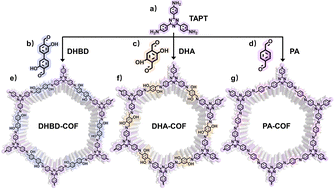
Graphical abstract: Hydroxyl-functionalized covalent organic framework enables high-affinity adsorption of myricetin

Supplementary files

Transparent peer review

To support increased transparency, we offer authors the option to publish the peer review history alongside their article.

View this article’s peer review history

Article information

Article type
Paper
Submitted
20 Mar 2026
Accepted
09 May 2026
First published
26 May 2026

New J. Chem., 2026, Advance Article

Hydroxyl-functionalized covalent organic framework enables high-affinity adsorption of myricetin

S. Wei, X. Peng, L. Bai, W. Wei, F. Zhang, C. You and F. Wang, New J. Chem., 2026, Advance Article , DOI: 10.1039/D6NJ01045H

To request permission to reproduce material from this article, please go to the Copyright Clearance Center request page.

If you are an author contributing to an RSC publication, you do not need to request permission provided correct acknowledgement is given.

If you are the author of this article, you do not need to request permission to reproduce figures and diagrams provided correct acknowledgement is given. If you want to reproduce the whole article in a third-party publication (excluding your thesis/dissertation for which permission is not required) please go to the Copyright Clearance Center request page.

Read more about how to correctly acknowledge RSC content.

Social activity

Spotlight

Advertisements