


 PLATFORM UPDATE:


A combined computational and experimental study for designing balanced tetrazole-based energetic materials
 *a
and
*a
and
Abstract
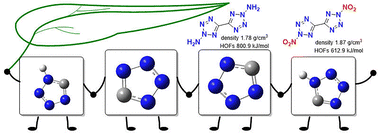
Herein, we present an integrated computational and experimental strategy for the rational design of tetrazole-based energetic materials that can overcome the classical trade-off between high energy density and low sensitivity. Theoretical screening identified tetrazole-based molecular skeletons as promising energetic candidates, exhibiting predicted densities of up to 2.02 g cm−3 and enhanced stability, which was attributed to widened HOMO–LUMO gaps (6.56–8.68 eV) and the stabilizing influence of the introduced energetic tetrazole-skeleton. Further analysis of model systems (molecules I-09 and II) confirmed strong aromaticity and stable dimer formation governed by van der Waals and electrostatic interactions. Guided by these computational insights, derivatives A and B were synthesized using I-09 and II as structural templates. The derivative A exhibited a high thermal decomposition onset (Td: 217.55 °C) and relatively lower sensitivity. Single-crystal X-ray diffraction analysis of derivative A revealed a well-defined “face-to-face” π–π stacking arrangement, arising from weak intermolecular interactions. Collectively, this study demonstrated that precise control over both the electronic structure and the solid-state arrangement enabled an effective balance between detonation properties and sensitivity. The consistency between theoretical predictions and experimental validation established a reliable design strategy for the development of advanced and insensitive high-energy materials.
 Please wait while we load your content...


