


Facile preparation of polyethyleneimine functionalized MXene nanosheets for enhanced adsorption and reduction of Cr(vi) from aqueous solutions: behaviors and mechanisms
 *ab
Mingyan
Chen
ab
and
*ab
Mingyan
Chen
ab
and
Abstract
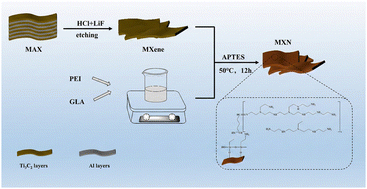
An innovative adsorbent combining PEI and MXenes was developed using a straightforward grafting technique to enhance Cr(VI) wastewater remediation. The PEI modification introduced abundant amino groups as active adsorption sites, accomplishing a high-capacity adsorption of 557.79 mg g−1 under the experimental conditions, surpassing that of the original MXene by 4.8 times. The adsorption mechanism revealed that Cr(VI) undergoes redox-mediated reduction to less toxic Cr(III) during the adsorption process, which is subsequently immobilized on the adsorbent via Ti–O–Cr and N → Cr interactions. These findings demonstrate that PEI/MXene exhibits significant potential to treat wastewater polluted with Cr(VI). The synthesized adsorbents were comprehensively characterized to evaluate their structural and surface properties. The introduction of PEI effectively modulates the charge properties of MXene layers and enhances the adsorbent–Cr(VI) electrostatic interaction. The adsorption mechanism is effectively characterized by the model of pseudo-second-order kinetics and aligns with the Freundlich isotherm theory. Following the completion of five adsorption–desorption cycles, the as-prepared adsorbent still maintained an outstanding removal rate of 84.16% for Cr(VI). Furthermore, PEI/MXene demonstrated a remarkable ability to selectively target Cr(VI) amidst a variety of other cations and anions.
 Please wait while we load your content...


