


Reactivity study of 4-hydroxydithiocoumarin/4-hydroxythiocoumarin with vinyl ether/cyclic vinyl ether: synthesis of fused novel thiophene derivatives using CuO nanoparticles
 b
and
Abu Taleb
Khan
*a
b
and
Abu Taleb
Khan
*a
Abstract
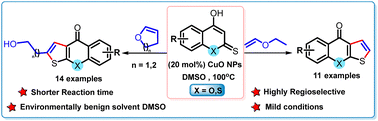
A reactivity study of 4-hydroxydithiocoumarin/4-hydroxythiocoumarin with vinyl ether was conducted in the presence of copper oxide nanoparticles (CuO NPs) in DMSO, and we developed a new methodology for the synthesis of fused thiophene derivatives. The products were obtained by eliminating the ethoxy group from the vinyl ether. Interestingly, similar reactions were also feasible with cyclic vinyl ethers and 4-hydroxydithiocoumarin, and ring opening took place to afford 4H-thieno[2,3-b]thiochromen-4-one derivatives with an alkyl alcohol substituent at the C2 position of the desired product. Notably, when the reactivity was examined with CuI and K2CO3 in toluene rather than with CuO NPs in DMSO, the reaction pathway changed considerably, leading to the formation of different products, as recently reported. DFT energy calculations were performed to determine the reaction mechanism for product formation. The proposed methodology offers several advantages, including excellent atom economy, shorter reaction times, mild conditions, the use of the environmentally benign solvent DMSO, and good yields.
 Please wait while we load your content...


