


 PLATFORM UPDATE:


A floating triphase photothermal platform: MoS2/SnS2 on fly ash for efficient CO2 reduction and tetracycline degradation

Abstract
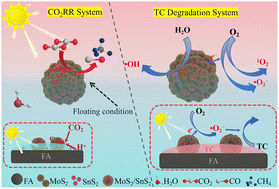
The rational design of efficient, dual-functional photocatalysts that operate under ambient conditions remains a significant challenge. Herein, we engineer a photothermal-driven, self-floating catalyst by anchoring a black MoS2/SnS2 heterojunction on waste-derived fly ash (MoS2/SnS2-FA). This configuration ingeniously creates a triphase (gas–liquid–solid) reaction interface, overcoming mass-transfer limitations inherent in conventional gas–solid or liquid–solid systems. Under simulated solar irradiation without external heating, the optimized MoS2/SnS2-FA achieves a CO production rate of 329.7 µmol g−1 h−1 and a CH4 production rate of 112 µmol g−1 h−1, with a CH4 selectivity of 25.4% among carbonaceous products, which is 3.4 to 16.4 times higher than its counterparts in biphasic configurations, and simultaneously delivers 91.2% tetracycline degradation within 60 minutes. In situ spectroscopic analyses confirm the formation of key intermediates (e.g., adsorbed COOH* and CO*) during CO2 reduction. The enhanced performance stems from a synergistic interplay: the type-II heterojunction establishes a built-in electric field that drives spatial separation of photogenerated charges, while the black MoS2 acts as a potent photothermal converter, locally elevating the interfacial temperature to accelerate reaction kinetics. This work provides a sustainable strategy for concurrent CO2 valorization and pollutant degradation through triphase photothermal catalysis.
 Please wait while we load your content...


